Cryptocurrency Custody
The phrase “Not your keys, not your coins” has become a rallying cry in the crypto world. But for institutions managing millions—or even billions—of dollars in digital assets, the decision between custodial and non-custodial wallet structures isn’t just ideological.
It’s about regulatory compliance, governance, security design, and operational resilience.
In this article, we break down the core differences, examine their implications for institutional operations, and show how hybrid custody models, like those offered by B2Vault, can deliver the best of both worlds.
A custodial wallet is one where a third party (custodian) holds and manages the private keys on behalf of the end user or institution.
When you use a custodial wallet, you’re delegating the responsibility for key management—and often transaction execution, security, and recovery processes—to another entity.
Key characteristics of custodial wallets:
For retail users, examples include exchange wallets (e.g., Kraken, Gemini), and institutional custodians such as BitGo or Anchorage.
For institutions, custodial wallets are often selected to outsource operational burden, satisfy regulatory requirements, and access insurance-backed infrastructures.
👉 Kraken frames custodial wallets as solutions where users rely on the custodian’s “expertise and infrastructure,” but must trust them with key control.
👉 BitGo highlights their security layers, compliance standards, and multi-sig architecture as institutional custodial strengths.
A non-custodial wallet is one where the user or institution retains full control of the private keys—and therefore, full responsibility for security, recovery, and transaction execution.
Key characteristics of non-custodial wallets:
For retail users, non-custodial typically means Ledger or MetaMask: the individual writes down their seed phrase and manages security personally.
For institutions, non-custodial custody often involves dedicated key management systems, multi-party computation (MPC) frameworks, hardware security modules (HSMs), and strict internal governance.
👉 Ledger markets their devices as giving users “full control,” while Gemini’s educational content notes that this also means full accountability for losses.
| Dimension | Custodial Wallet | Non-Custodial Wallet |
| Key Ownership | Held by third party (custodian) | Held directly by user/institution |
| Security Responsibility | Custodian secures keys | Institution manages own security stack |
| Regulatory Alignment | Often preferred in regulated markets (outsourced compliance, insurance) | Requires internal compliance framework and clear governance |
| Operational Control | Limited — subject to custodian’s processes | Full — institution sets policies and controls |
| Speed & Flexibility | Depends on custodian workflows | Potentially faster, but depends on internal tech |
| Recovery & Backup | Managed by custodian | Institution must design and maintain recovery |
| Counterparty Risk | Custodian insolvency or breach is a factor | No third-party counterparty risk |
| Internal Governance Needs | Low (outsourced) | High (must implement signing policies, RBAC, audits) |
| Transparency | Dependent on custodian’s reporting | Full on-chain visibility and internal logs |
Institutional custodial wallets have grown rapidly because they offer:
For some institutions—especially regulated funds, payment providers, or fintech platforms—using a licensed custodian is not just a preference; it’s a requirement.
On the other hand, many institutions are increasingly moving toward non-custodial models powered by MPC (multi-party computation) and enterprise key orchestration. This shift is driven by:
However, this comes with the need for serious internal controls: robust key management infrastructure, strict role-based access, redundancy plans, and regular audits.
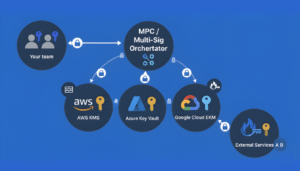
The binary between custodial and non-custodial is fading. Modern institutional custody increasingly blends both approaches:
This hybrid custody model allows institutions to retain control over critical assets while leveraging custodial infrastructure for compliance, settlement, or operational support.
At B2Vault, we believe institutions shouldn’t have to choose between control and compliance.
Our platform provides:
Whether you’re a fund managing treasury, a payment company processing client flows, or a crypto-native firm scaling operations, B2Vault gives you the flexibility to define your custody model on your terms.
The choice between custodial and non-custodial wallets is not just a technological decision — it’s a strategic governance choice.
In the institutional world, the smartest custody strategy is the one that blends security, compliance, and operational excellence.
B2Vault is a next-generation digital asset custody platform built for institutions. By combining MPC cryptography, tiered custody architecture, and enterprise-grade governance, we help organizations securely manage their digital assets across multiple jurisdictions and chains.